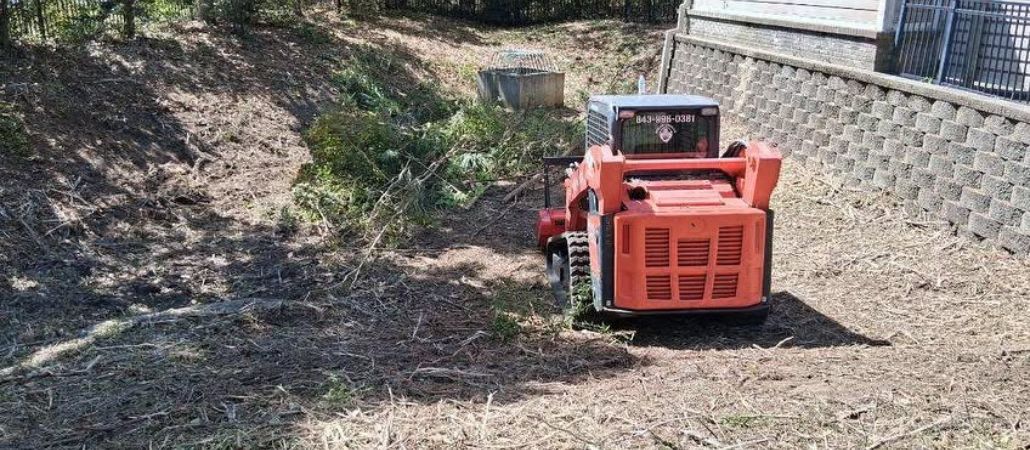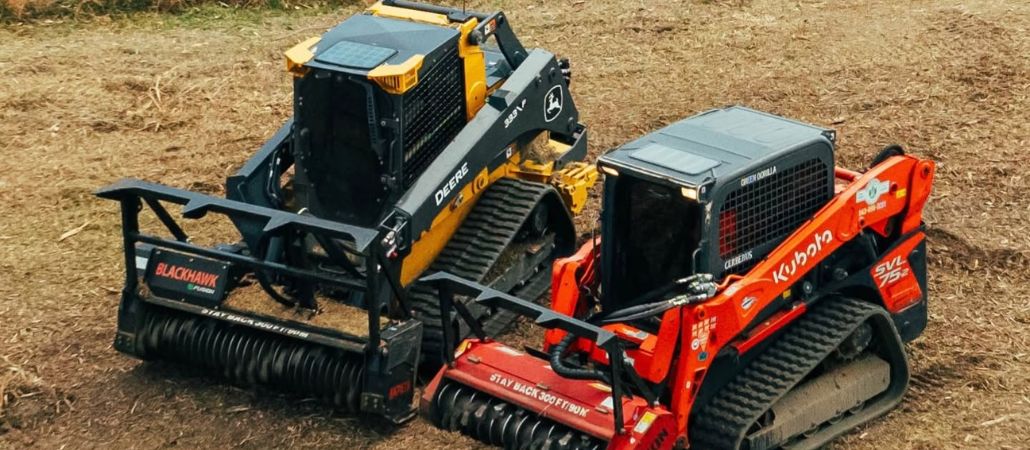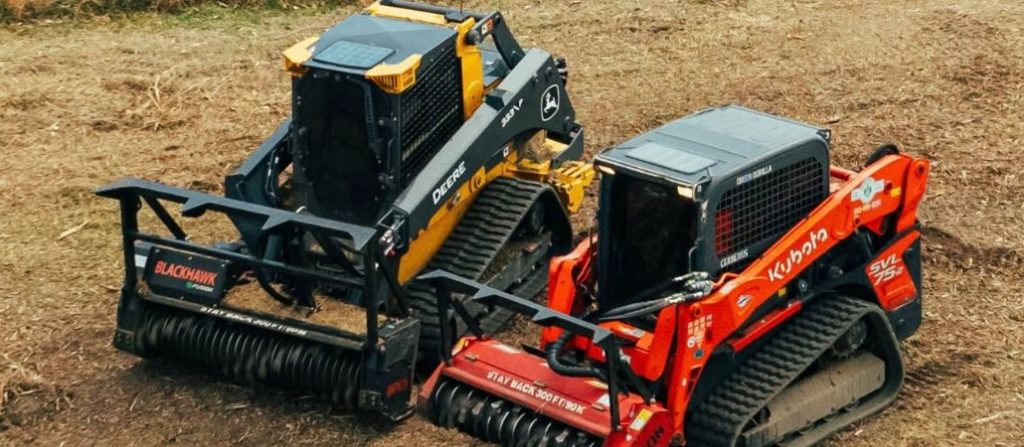
Forestry mulching operations are conducted by using a tracked machine with a high-powered mulching head to mulch and grind in place standing brush, saplings, vines, underbrush, and small trees into chips that get recycled back onto the ground and benefit the organic soil.
One important distinction, because it drives cost and expectations: forestry mulching grinds surface vegetation and material down at or near ground level, pending the topography and other conditions. This process is not the same as excavating a site or pulling the root systems out of the ground. If your project needs stumps removed, that is separate work.
We do offer land clearing services and stump grinding services as part of our land management operations, and we’ll let you know up front whether your project needs it. Anyone who tells you mulching automatically eliminates every stump and root on a site is overselling it.
How Much Does Forestry Mulching Cost in the Charleston Lowcountry?
Green Gorilla Land Management does not offer a flat per-acre price for forestry mulching in Charleston, SC, because the real cost depends on what is growing on your property: how dense it is, how large the saplings and trees are in diameter along with height, how much area of the land you need cleared, how well the machine can reach the work, and what you want the finished ground to look like. Jobs can range from $1,500.00 to $15,000.00 or more, depending on the scope of work and vegetation desired to be removed. A site assessment is the most reliable way to define the scope of work and agreed-upon price. Request a free estimate or call (843) 996-0381 to get started.
Below is exactly what we look at when we price a job, so you can judge any estimate you receive — whether it’s ours or someone else’s.
What Drives the Price
Vegetation Density and Size
Density is the biggest factor. Light overgrowth on an open lot goes fast. A parcel that has not been touched in a decade — thick vines, heavy underbrush, larger saplings and trees, layered canopy, etc. — takes far more machine time per acre. Kudzu, Chinese privet, and other invasive species of vegetation create some of the densest conditions in the region and sit at the higher end of any estimate.
Stem and tree size matter as much as density. Mulching is efficient on brush, underbrush, and small trees. Larger hardwoods change the approach and the price.
Acreage and Scope
Total acreage sets the size of the job, but scope sets the effort. Clearing an entire parcel is a different job than opening a fence line, cutting an access trail, or thinning underbrush while leaving mature trees standing. Selective clearing takes more care and more time per acre than a full pass.
Mobilization is real, too. Getting equipment to your site costs the same whether we clear a half acre or five, which is why very small jobs rarely feel “cheap per acre” and larger jobs usually spread that cost further.
Site Access and Ground Conditions
How close can equipment get to the work? Is there a gate, a bridge, a soft low spot, a ditch, overhead lines, or a neighbor’s fence to protect? Wet ground after a Lowcountry rain slows everything down. Our tracked setup handles conditions that stop other machines, but access still affects how long a job takes — and time is what you are paying for.
Finish Level
“Cleared” means different things to different owners. Knocking down a fuel load along a property edge is one standard. A clean, walkable, mow-ready surface is another. Tell us how you plan to use the land — pasture, hunting access, a build site, resale showings — and we’ll price to that finish instead of guessing.
Obstacles and Debris Already on the Ground
Old fencing, wire, trash piles, scrap metal, and storm-downed material hidden in the brush all slow the work and can damage equipment. If you know something is out there, mention it during the site walk. It’s cheaper to plan for than to discover.
Is Mulching Cheaper Than Traditional Clearing?
Sometimes — not always. It depends on the property and the goal. What forestry mulching genuinely changes is the number of steps and provides efficient and effective ways to reclaim overgrown property.
Conventional clearing often means cutting, piling, then hauling or burning debris, with the disposal handled separately. Mulching consolidates cut-and-process into one machine and leaves the material on site as an eco-friendly cover, which removes hauling and disposal from the equation and reduces ground disturbance.
On overgrown brush, underbrush, invasives, trails, and fence lines, that usually makes it the more efficient option.
Where it’s not the answer: sites needing full stump and root removal, grading, or hauling everything off for construction. In those cases, mulching may still be a smart first phase — it makes the site visible and safe to work — but it is not a substitute for excavation. We’ll tell you honestly which situation you are in.
The other value most owners overlook is what the mulch does after we leave. It covers bare soil, helps hold ground against erosion, and breaks down over time, which is a meaningful benefit on the sandy, wet, low-lying ground common across the Lowcountry.
When Forestry Mulching Is the Right Call
Property owners around Charleston typically use it for:
- Overgrowth and underbrush clearing — reclaiming land that has not been maintained in years
- Invasive species removal — knocking back kudzu, privet, and aggressive vines taking over native growth
- Fire break creation and fuel load reduction — reducing heavy growth along property edges
- Trail and access clearing — opening usable paths through wooded property
- Habitat restoration — clearing invasives so native plants and wildlife can come back
- Erosion control support — leaving protective ground cover instead of bare soil
- Pre-sale and pre-project cleanup — making a parcel visible and walkable for buyers, surveyors, or planning
If your project is heavier on standing trees or needs a truly blank site, start with our land clearing services. If it is mostly brush and vines, brush clearing may be the better fit. Same crew, same machine, different approach — and we will recommend the one that fits, not the one with the bigger invoice.
How to Get an Accurate Quote
- Reach out. Call (843) 996-0381 or use the contact form. Photos, an address, and rough acreage help us prepare.
- Tell us the goal. How you intend to use the land determines the finish level we price to.
- We assess the property. We look at density, stem size, access, ground conditions, and obstacles.
- You get it in writing. A written estimate with the scope spelled out, so there are no surprise line items once work starts.
Estimates are free. If mulching is not the right method for what you are trying to do, we will say so.
Frequently Asked Questions
No. Two parcels of the same size can require very different amounts of machine time. Density, stem size, access, terrain, and the requested finish all affect the scope.
Not automatically. Mulching grinds surface vegetation and material at or near ground level. Stump grinding is a separate service we offer through land clearing, and full root removal is excavation work.
It stays on your property as mulch cover, which is why there are no hauling or disposal steps in a standard mulching job.
Some regrowth is normal in this climate, especially with invasives. Many owners schedule periodic maintenance passes to keep ground they have already reclaimed.
Often, yes. We run a tracked machine that reaches areas wheeled equipment and tractors cannot due to terrain, mud, and ruts. We will confirm during the site walk.
Green Gorilla serves the greater Charleston area, including Charleston, Hollywood, Ravenel, Meggett, Edisto Island, Summerville, Cottageville, Lady’s Island, Beaufort, and Hilton Head. We do travel to other areas, so please inquire.
Get a Real Number for Your Property
Green Gorilla Land Management is a licensed and insured, local, veteran-owned small business that has been clearing Lowcountry land since 2019. You can read more about our team and equipment — or skip ahead and get your property looked at.
Call (843) 996-0381 or request your free estimate. We will walk the site, tell you what it will actually take, and put the price in writing.